Mycoplasma probe-based assay
Mycoplasma probe-based assay
A probe-based Mycoplasma assay utilizes real-time PCR technology to accurately detect Mycoplasma contamination through the amplification of a specific region of the Mycoplasma genome. During the reaction, target-specific fluorescent probes bind to the amplified DNA product. As the amplification progresses, the accumulation of the PCR product leads to an increase in fluorescence signal from the bound probes. By monitoring fluorescence intensities throughout the PCR run, the system detects the accumulation of target sequences in real time, allowing for highly sensitive and specific identification of Mycoplasma DNA.
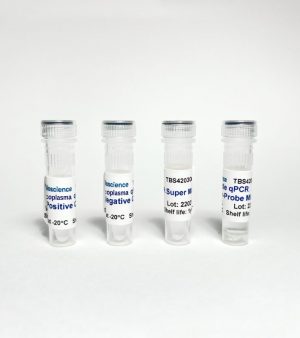
Tribioscience’s Mycoplasma qPCR Kit is designed based on this principle and provides a comprehensive solution for reliable Mycoplasma detection. The kit includes Mycoplasma positive and negative controls, internal PCR controls labeled with HEX, a high-performance qPCR supermix, and a primer-probe mix in which the probe is labeled with FAM for the target gene. The FAM-labeled probe emits a fluorescence signal indicating the presence of Mycoplasma DNA, while the HEX-labeled internal control confirms that the PCR reaction has performed correctly, ensuring valid and interpretable results.
This probe-based system enhances assay accuracy and minimizes the likelihood of false negatives or false positives. By using FAM and HEX fluorescent markers, Tribioscience’s probe-based Mycoplasma assay enables simultaneous detection of target DNA and internal control within a single reaction. The real-time monitoring of fluorescence provides rapid, reliable, and quantitative results, making it a valuable tool for research laboratories and biomanufacturing facilities that require stringent quality assurance and contamination control.
-
RT-PCR Kits
Mycoplasma Detection qPCR Kit (TBS42030)
Price range: $239.00 through $476.00Select optionsQuick View