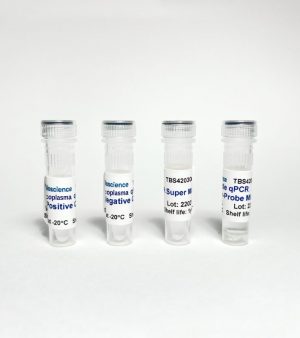
Mycoplasma fluorescence qPCR
Mycoplasma fluorescence qPCR
Fluorescent probe qPCR for Mycoplasma detection provides a highly sensitive and specific method for identifying contamination in biological materials. This technique relies on the amplification of a specific region of the Mycoplasma genome, with detection achieved through fluorescent probes that bind exclusively to the target DNA sequence. As the target DNA is amplified during the PCR process, the fluorescent signal intensifies, allowing real-time monitoring of amplification progress. This real-time fluorescence measurement enables precise quantification and accurate detection of Mycoplasma presence, ensuring reliable results in quality control and research applications.
Tribioscience’s Mycoplasma Fluorescent Probe qPCR Kit is designed to streamline and enhance the accuracy of Mycoplasma testing. The kit includes both positive and negative controls, as well as internal controls labeled with Hex, providing a comprehensive system to verify the accuracy and efficiency of each run. The target-specific probe, labeled with FAM, ensures that only Mycoplasma DNA is detected, eliminating the risk of cross-reactivity with other microbial species. These built-in controls not only validate assay performance but also help identify potential issues such as PCR inhibition or contamination, ensuring consistent and trustworthy outcomes.
By integrating internal and external controls within a single assay, the fluorescent probe qPCR method for Mycoplasma detection delivers both precision and reliability. The optimized qPCR super mix and ready-to-use primer-probe combination simplify the workflow, requiring only the addition of the DNA template and water. This system offers high amplification efficiency under optimal PCR conditions, making it ideal for laboratories seeking dependable and efficient Mycoplasma screening. Ultimately, the fluorescent probe qPCR approach safeguards research integrity by providing a rapid, accurate, and contamination-free method for authenticating cell cultures and biological materials.
-
RT-PCR Kits
Mycoplasma Detection qPCR Kit (TBS42030)
Price range: $239.00 through $476.00Select optionsQuick View