ATP Fluorometric Assay
ATP Fluorometric Assay
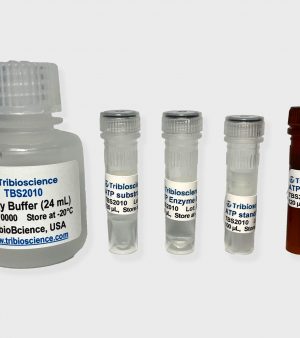
The Tribioscience ATP Colorimetric/Fluorometric Assay Kit (TBS2010) offers a sensitive and efficient method for quantifying adenosine triphosphate (ATP) in biological samples. By leveraging the phosphorylation of glycerol, the assay produces a detectable product measurable via fluorometric methods at excitation/emission wavelengths of 535/590 nm. This fluorometric approach enhances sensitivity, enabling detection of ATP concentrations as low as 0.5 µM. The assay is designed for simplicity and speed, requiring only 10 µL of sample and delivering results in under 30 minutes. Its broad detection range (0.5–1000 µM) makes it suitable for various applications, including monitoring ATP levels in cells and assessing enzyme activities related to ATP metabolism.
In bioluminescence studies, the sensitivity of ATP detection is crucial for accurate measurement of cellular energy states and metabolic activities. The TBS2010 kit’s fluorometric detection method significantly enhances sensitivity—reported to be 10 to 100 times higher than the colorimetric approach. This heightened sensitivity is particularly beneficial when working with low-abundance samples or when precise quantification of ATP is necessary. The assay’s compatibility with 96-well plate formats also facilitates high-throughput screening, making it a valuable tool for researchers conducting large-scale studies.
The assay protocol is straightforward: samples, such as tissue or cell lysates, are prepared and combined with the reaction mix, which includes assay buffer, substrate, probe, and enzyme. After a 20-minute incubation at room temperature, fluorescence is measured, and ATP concentrations are calculated using a standard curve. The kit’s components are stable when stored at -20°C, with a shelf life of three months, ensuring reliability over time. Overall, the TBS2010 kit provides a robust and sensitive method for ATP quantification, supporting diverse research applications in cellular and molecular biology.