Recombinant Tryptase Activity
Recombinant Tryptase α/β1 Activity
Introduction:
Tryptase is the most abundant preformed granular enzyme found in all human mast cells and is frequently used as a marker for mast cell activation. Tryptase has α, β, γ, and δ isoforms. Of the four isoforms of tryptase, β-tryptase and to a lesser extent α-tryptase, are considered the most biologically significant. The γ and δ forms of tryptase are believed to have little, if any, catalytic activity. α-tryptase and β1-tryptase alleles are co-allelic at the TPSAB1 gene locus, while TPSB2 only encodes β-tryptase.
Tryptase is a crucial enzyme in immune responses, particularly those involving mast cells. It plays a significant role in allergic reactions, inflammation, and tissue remodeling. Elevated tryptase levels in the blood serve as an important diagnostic tool for conditions such as anaphylaxis and mast cell activation disorders. Tryptase’s proteolytic activity and its ability to activate inflammatory pathways make it central to the body’s defense mechanisms, but its excessive or inappropriate activation can contribute to chronic inflammation and allergic diseases.
Human lung tryptase is used as a standard reference in tryptase activity analysis. But this enzyme is not available. To meet this requirement, Tribioscience Team developed recombinant tryptase α/β1 (TBP0099) and validated its enzymatic activity with Tryptase Activity Assay (TBS2101). The recombinant Tryptase displays strong enzymatic activity. This recombinant tryptase enzyme may be an excellent option for measuring tryptase enzymatic activity.
Materials:
Recombinant Tryptase a/β1 enzyme (TBP0099): 5µg/mL
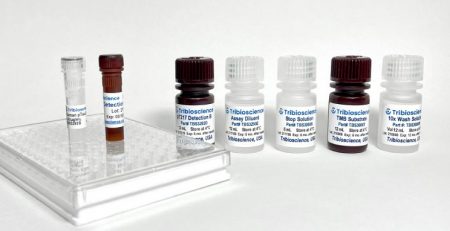
Tryptase Activity Colorimetric Assay (TBS2101).
M2 Microplate reader: SpectraMax M2 (Molecular Devices).
Procedures:
Tryptase Activity was measured with Tryptase Activity Colorimetric Assay Kit (TBS2101).
- Dilute 5µg/mL to 0.5µg/ml with Assay buffer, then do 5x serial dilution to generate 0.1 µg/mL, 0.02µg/mL, 0.004µg/mL. Assay buffer was used as zero.
- Add 180 µL of tryptase indicated well. Then add 20 µL substrate into each well.
- Incubate at 37℃ for the indicated time point.
- Read OD at 405nm at the indicated time points: 20 min, 30 min, 60 min, 90 min, 120 min, 150min and 15 hours. The OD value was subtracted from background control.

Results:
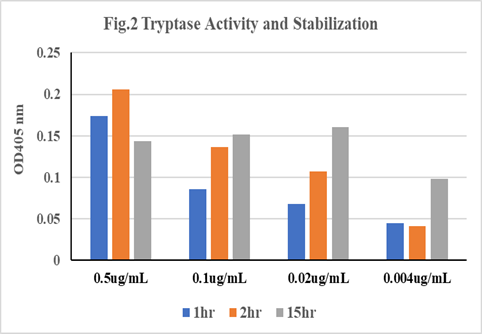
Recombinant tryptase displayed a great enzymatic activity detected by Tryptase Activity Colorimetric Assay Kit as shown in Fig.1. and Fig.2. We can summarize them as below:
- Enzymatic activity and concentration: The enzymatic activity was related to the concentration of the enzyme. The high concentration had a higher OD value which was used as an enzymatic activity indication. The enzymatic activity could be detected as low as 0.004 µg/mL concentration. 0.5 mg/mL had higher activity than other concentrations.
- Activity and incubation time: The enzymatic activity was relative to the incubation time as shown in Fig. 1. The enzyme had low activity in the incubation time of less than 60 minutes. After then, the enzyme displayed strong activity in the incubation time of 90 minutes to 150 minutes. The incubation time of 120 minutes to 150 minutes may be a good time window to determine enzymatic activity.
- Long-lasting enzymatic activity: The enzymatic activity was sustained for over 15 hrs at 37℃ demonstrated as Fig.2. It was a very valuable property for enzymatic activity analysis, and enzyme storage.
Summary:
Tribioscience’s Recombinant Tryptase Enzyme demonstrates strong enzyme activation. It may be an excellent alternative for tryptase enzyme analysis.
Relative Products:
Recombinant Tryptase a/β1 enzyme (TBP0099).
Tryptase Activity Colorimetric Assay (TBS2101).
Contact Information:
Tribioscience, Inc.
1-833-697-8998 or 408-498-0197