XTT assay
XTT assay
The XTT assay is a colorimetric technique designed to assess cell viability by measuring mitochondrial activity. It operates on the principle that living cells possess active mitochondrial oxidoreductases, which facilitate the reduction of the yellow tetrazolium salt XTT into an orange-colored formazan dye. This reduction process is enhanced by electron acceptors or coupling reagents and occurs exclusively in metabolically active cells. The resulting orange formazan is water-soluble, allowing for direct quantification by measuring absorbance at 450 nm using a spectrophotometer. The intensity of the color produced correlates with the number of viable cells present in the sample.
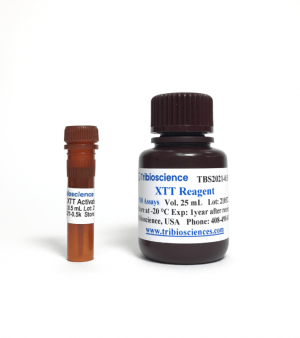
TribioScience’s XTT Cell Viability Assay Kit offers a streamlined and safe method for evaluating cell proliferation and cytotoxicity. The assay eliminates the need for additional reagents, washes, or cell transfer steps, making it suitable for high-throughput applications. Its non-radioactive nature ensures safety during handling. The kit is versatile, applicable for measuring cell proliferation in response to various stimuli such as growth factors, cytokines, mitogens, and nutrients. Additionally, it is effective in analyzing the cytotoxic effects of compounds like anticancer drugs and other pharmaceutical agents.
To perform the assay, cells are cultured in a 96-well plate, with each well containing 100 µL of growth medium and a cell density ranging from 1,000 to 10,000 cells. After including appropriate controls and blanks, the XTT reagent and activation reagent are warmed to 37°C and mixed in a 1:50 ratio to prepare the working solution. Subsequently, 50 µL of this solution is added to each well, and the plate is incubated at 37°C for 2 to 4 hours. Post-incubation, the plate is gently shaken to ensure even color development, and absorbance is measured at 450 nm. The absorbance values obtained are directly proportional to the number of viable cells, providing a quantitative measure of cell viability.
-
 Biochemical Assays
XTT Cell Viability Assay (TBS2021)
Price range: $98.00 through $189.00Select optionsQuick View