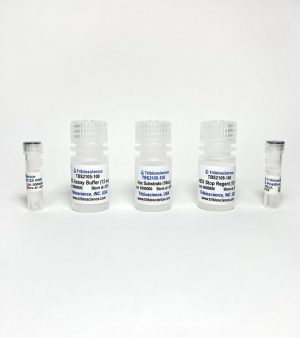
Fluorometric assay for Beta-NAG
Fluorometric assay for Beta-NAG
The fluorometric assay for β-N-Acetylglucosaminidase (β-NAG) offers a highly sensitive and straightforward approach to detect enzymatic activity through fluorescence emission. β-NAG, also known as β-Hexosaminidase, is a lysosomal enzyme present in tissues such as the kidneys, liver, lungs, and mast cells. Its activity is clinically relevant, as elevated levels are associated with disorders like Tay-Sachs and Sandhoff disease, as well as conditions involving inflammation and abnormal immune responses. In this assay, a fluorometric method is employed to monitor the enzymatic cleavage of a specific substrate, resulting in the emission of a measurable fluorescent signal.
The assay utilizes the non-fluorescent substrate 4-Methylumbelliferyl N-acetyl-β-D-glucosaminide (4-MUAG), which is specifically cleaved by β-NAG to release the fluorescent molecule 4-Methylumbelliferone (4-MU). The reaction is detected by measuring fluorescence at an excitation wavelength of 365 nm and an emission wavelength of 445 nm. This kinetic reaction enables researchers to accurately quantify β-NAG activity in a range of biological samples, including tissues, cells, serum, and urine. The inclusion of a positive control, standard, and optimized reagents ensures reliable performance across multiple experimental conditions.
Designed for both research and high-throughput screening applications, this fluorometric assay kit is adaptable for automation, making it suitable for processing large numbers of samples daily. The assay’s linear detection range and fast reaction time (30 minutes at 37°C) allow for efficient workflows without compromising sensitivity. With a 12-month shelf life when stored at -20°C and components supplied in ready-to-use concentrations, the kit offers convenience and consistency for laboratories studying lysosomal enzyme function and associated pathologies.
-
 Biochemical Assays
Beta-N-Acetylglucosaminidase (Beta-NAG) Activity Fluorometric Assay (TBS2105F)
Price range: $390.00 through $690.00Select optionsQuick View