Beta-NAG enzyme assay for inflammation monitoring
Beta-NAG enzyme assay for inflammation monitoring
The Beta-NAG enzyme assay provides a powerful tool for monitoring inflammatory conditions by measuring the activity of β-N-Acetylglucosaminidase (β-NAG), a lysosomal enzyme linked to immune and inflammatory responses. β-NAG is naturally present in tissues such as the kidneys, liver, lungs, and mast cells. Under pathological conditions, including chronic inflammation or immune dysregulation, its activity becomes markedly elevated. This makes β-NAG a valuable biomarker for assessing the extent and presence of inflammation in various biological systems.
Using the β-N-Acetylglucosaminidase Activity Fluorometric Assay, researchers can accurately evaluate β-NAG activity in samples such as tissues, cultured cells, serum, or urine. The assay employs 4-Methylumbelliferyl N-acetyl-β-D-glucosaminide (4-MUAG), a non-fluorescent substrate that, upon enzymatic cleavage by β-NAG, releases 4-Methylumbelliferone (4-MU). The resulting fluorescent signal—detected at 365 nm excitation and 445 nm emission—offers a quantifiable readout of enzyme activity. With a linear detection range and a short 30-minute incubation time at 37°C, this assay enables sensitive detection, even in low-volume samples.
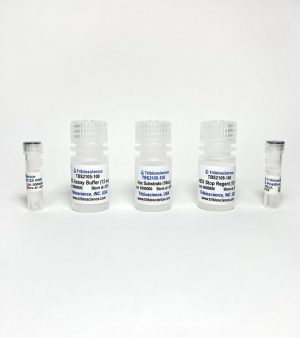
Designed for high-throughput screening, the Beta-NAG enzyme assay is well-suited for research workflows, especially in studies involving inflammation-related diseases such as autoimmune disorders or lysosomal storage diseases like Tay-Sachs and Sandhoff. The kit components, optimized for consistency and ease of use, include substrate, assay buffer, a positive control, and stop reagent, allowing for reproducible results across large sample batches. By tracking β-NAG activity, this assay supports dynamic monitoring of inflammation, offering insights into disease progression, therapeutic response, or immune activation states.
-
 Biochemical Assays
Beta-N-Acetylglucosaminidase (Beta-NAG) Activity Fluorometric Assay (TBS2105F)
Price range: $390.00 through $690.00Select optionsQuick View