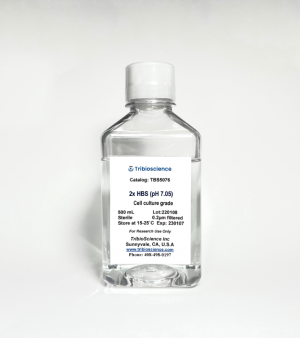
HBS for virus production
HBS for virus production
HBS (HEPES-Buffered Saline) is a widely used buffer system in molecular biology and virology, particularly valuable for virus production protocols. Its carefully balanced pH and osmotic conditions create an optimal environment for transfection and viral vector generation, which are highly sensitive to fluctuations in culture conditions. By providing a stable and physiologically relevant buffering system, HBS enables researchers to carry out virus production with reduced variability and improved reproducibility across experiments. This stability is crucial in ensuring that viral yields remain high and consistent.
For viral vector production, consistency is a key requirement, as small differences in culture conditions can lead to significant variations in viral titers. HBS supports this process by minimizing stress on producer cells and optimizing the uptake of nucleic acids during transfection, which directly influences viral particle generation. This makes HBS an essential component for protocols that demand reliability, especially when scaling from small-scale laboratory experiments to larger production runs. The use of HBS for virus production ensures that researchers obtain high-titer viral vectors with reduced batch-to-batch variability.
The ability of HBS to provide reliable results has made it a trusted tool in molecular biology research. In gene therapy research, vaccine research, and functional genomics studies, high-quality viral vectors are essential for advancing scientific discoveries. By offering consistent and reproducible conditions for virus production, HBS helps accelerate progress in these areas while reducing experimental variability and improving overall efficiency. Ultimately, HBS contributes to the production of high-performing viral vectors that are foundational to fundamental research.