Tissue and fluid sample analysis in Beta-NAG
Tissue and fluid sample analysis in Beta-NAG
The β‑N‑Acetylglucosaminidase (β‑NAG) Activity Fluorometric Assay offers a highly efficient method for easily quantifying β‑NAG activity in tissue lysates, serum, urine, or cell extracts. Leveraging the non‑fluorescent substrate 4‑Methylumbelliferyl N‑acetyl‑β‑D‑glucosaminide (4‑MUAG), the assay releases the fluorescent product 4‑Methylumbelliferone (4‑MU), which is then measured at an excitation wavelength of 365 nm and emission at 445 nm. This kinetic approach ensures fast, reliable, and reproducible quantification of hexosaminidase activity across a variety of biological matrices.
Primarily a lysosomal enzyme, β‑NAG (also known as β‑Hexosaminidase, EC 3.2.1.52) is ubiquitously expressed in tissues such as kidney, liver, lung, and mast cells. Its elevated activity correlates with disorders including Tay–Sachs and Sandhoff disease, as well as inflammatory conditions and immune dysregulation. This assay kit’s fast and sensitive detection range—achievable in just 30 minutes at 37 °C with a minimal 20 µL sample volume—enables accurate monitoring across different sample types including serum and urine.
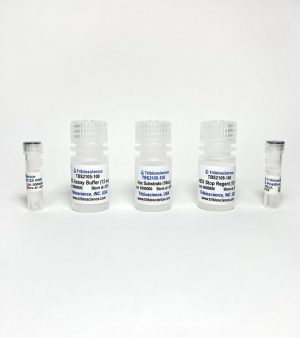
Designed for high throughput versatility, the kit is suitable for automation on HTS liquid‑handling systems, allowing efficient processing of thousands of samples per day. Supplied with substrate, positive control, standard, assay buffer, and stop reagent, the kit supports 100× or 200× reactions and benefits from a 12‑month shelf life when stored at –20 °C. With a streamlined kinetic protocol—emphasizing rapid substrate addition, uniform incubation, and brief yet thorough mixing using multichannel pipettors—this kit provides an ideal solution for sensitive and scalable β‑NAG analysis in research.
-
 Biochemical Assays
Beta-N-Acetylglucosaminidase (Beta-NAG) Activity Fluorometric Assay (TBS2105F)
Price range: $390.00 through $690.00Select optionsQuick View