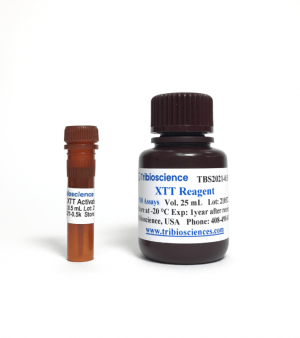
XTT reagent
XTT reagent
The XTT reagent, formally known as 2,3-bis(2-methoxy-4-nitro-5-sulfophenyl)-5-[(phenylamino)carbonyl]-2H-tetrazolium hydroxide, is a tetrazolium-based compound widely utilized to assess metabolic activity in living cells. Upon entering metabolically active cells, XTT undergoes reduction by mitochondrial oxidoreductases, leading to the formation of an orange-colored formazan dye. This dye is water-soluble, allowing for direct quantification by measuring absorbance at 450 nm without the need for additional solubilization steps. The intensity of the color produced is directly proportional to the number of viable cells, making the XTT assay a reliable method for evaluating cell proliferation, viability, and cytotoxicity.
Compared to other tetrazolium-based assays, the XTT assay offers several advantages. Notably, the water solubility of its formazan product eliminates the need for solubilization steps required in similar assays, streamlining the procedure and reducing potential variability. Additionally, the XTT assay is non-radioactive and can be performed directly in 96-well microplates, facilitating high-throughput screening. Its sensitivity and simplicity make it suitable for various applications, including testing the effects of growth factors, cytokines, and cytotoxic agents on cell metabolism.
In practical applications, the XTT assay involves culturing cells in a 96-well plate, adding the XTT reagent along with an activator, and incubating the plate to allow for the reduction of XTT to formazan by metabolically active cells. After incubation, the absorbance is measured at 450 nm using a spectrophotometer. This straightforward protocol enables researchers to efficiently assess cell viability and proliferation across multiple samples, making the XTT assay a valuable tool in cell biology and pharmacological research.
-
 Biochemical Assays
XTT Cell Viability Assay (TBS2021)
Price range: $98.00 through $189.00Select optionsQuick View